

ECC-Net Calls for Stronger Enforcement to End IBAN Discrimination in the EU
Despite clear EU legislation guaranteeing cross-border access to banking services, consumers across the EU are still being denied the right to use their bank accounts, simply because they are held in another Member State. To address this issue, the European Consumer Centres Network (ECC-Net) has published a new position paper calling for stronger enforcement of existing rules.
What is IBAN discrimination?
IBAN discrimination occurs when a business, public authority, or payment service provider refuses to accept a SEPA (Single Euro Payments Area) credit transfer or direct debit simply because the consumer’s International Bank Account Number (IBAN) is located in a different EU country.
This practice is explicitly prohibited. Yet despite these rules, ECC-Net continues to receive complaints from consumers who are blocked from making payments for essential services — including insurance, utilities, school fees, train subscriptions, and even public sector payments such as taxes or social benefits — solely because of their foreign IBAN.
Why it still happens
While some enforcement authorities have acted against IBAN discrimination by issuing fines, creating complaint mechanisms, or incorporating EU provisions into national law, the implementation and levels of enforcement vary significantly across Member States.
Adding to the challenge, the SEPA Regulation is not currently part of the EU’s coordinated consumer law enforcement framework. This lack of alignment makes it harder for countries to cooperate when cross-border complaints arise.
Furthermore, outdated IT systems and fraud-prevention policies are frequently cited as reasons by companies refusing to accept foreign IBANs. But these barriers are not acceptable in the EU’s single market, especially when tools like instant payments and payee verification are readily available. Additionally, just as consumers are often referred to simplified judicial procedures to resolve cross-border issues, traders can be expected to engage in these procedures in case of non-payment problems, rather than avoiding the risk by declining foreign IBAN accounts altogether.
ECC-Net’s insights: complaints from across Europe
ECC has had regular exchanges with the The 'Accept my IBAN' initiative – an initiative which aims to ensure that individuals and businesses can use their IBANs from any EU or EEA country without facing discrimination. They have gathered evidence of 4,688 consumer complaints between 2021 and early 2025, primarily from France, Germany, Spain, and Italy. Many of these cases concern:
- Financial services (26%)
- Telecommunications (23%)
- Public services (16%)
ECC-Net also has extensive experience when it comes to this topic, and every year the network reports cases in which direct debits were refused by traders within the EU.
ECC-Net calls to action
To close the gap between EU law and everyday reality, ECC-Net calls upon EU institutions and national governments for stronger, more consistent, and dissuasive enforcement of the existing legislation by national authorities and EU institutions alike.
The existing rules need to be enforced firmly and consistently, to show that IBAN discrimination is unacceptable.
Want to know more?
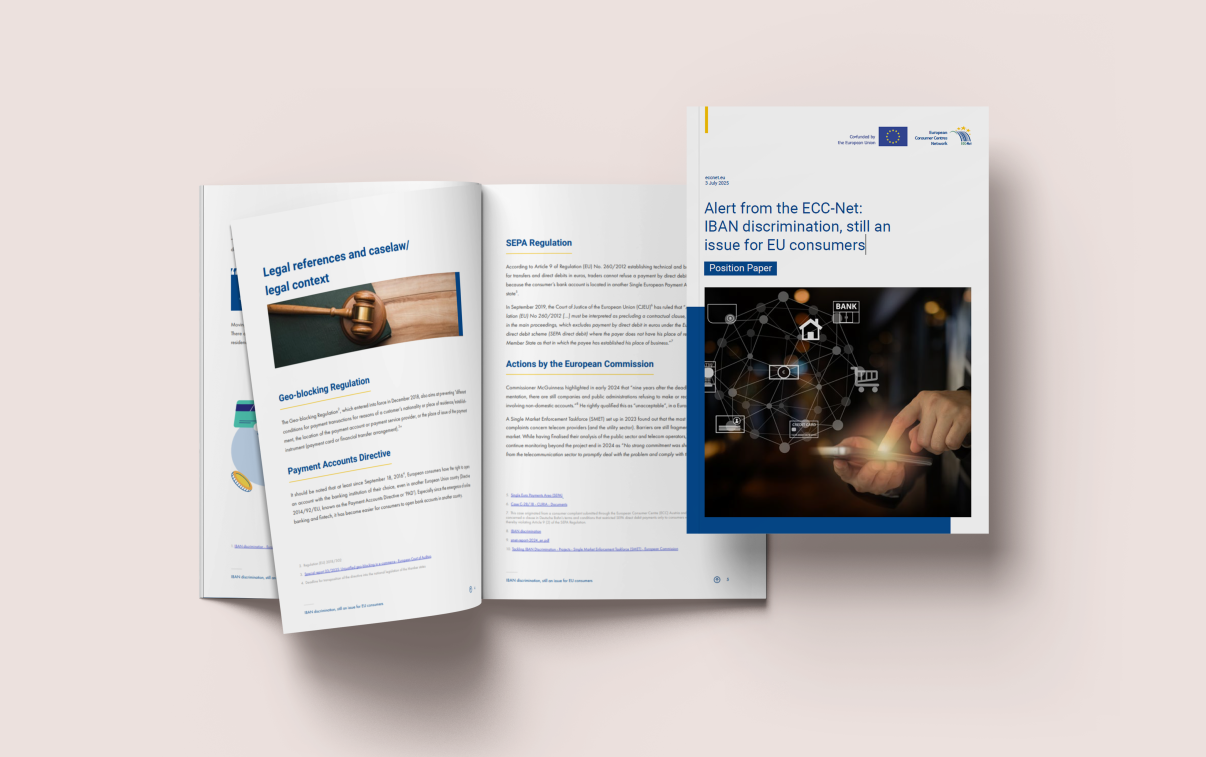
Read our full position paper: Alert from the ECC-Net: IBAN Discrimination – Still an Issue for EU Consumers
It outlines the legal framework, shares data from thousands of cases, and offers targeted recommendations to finally end IBAN discrimination in practice — not just on paper.