

ECC-Net’s Recommendations to Address Unfair Car Rental Practices
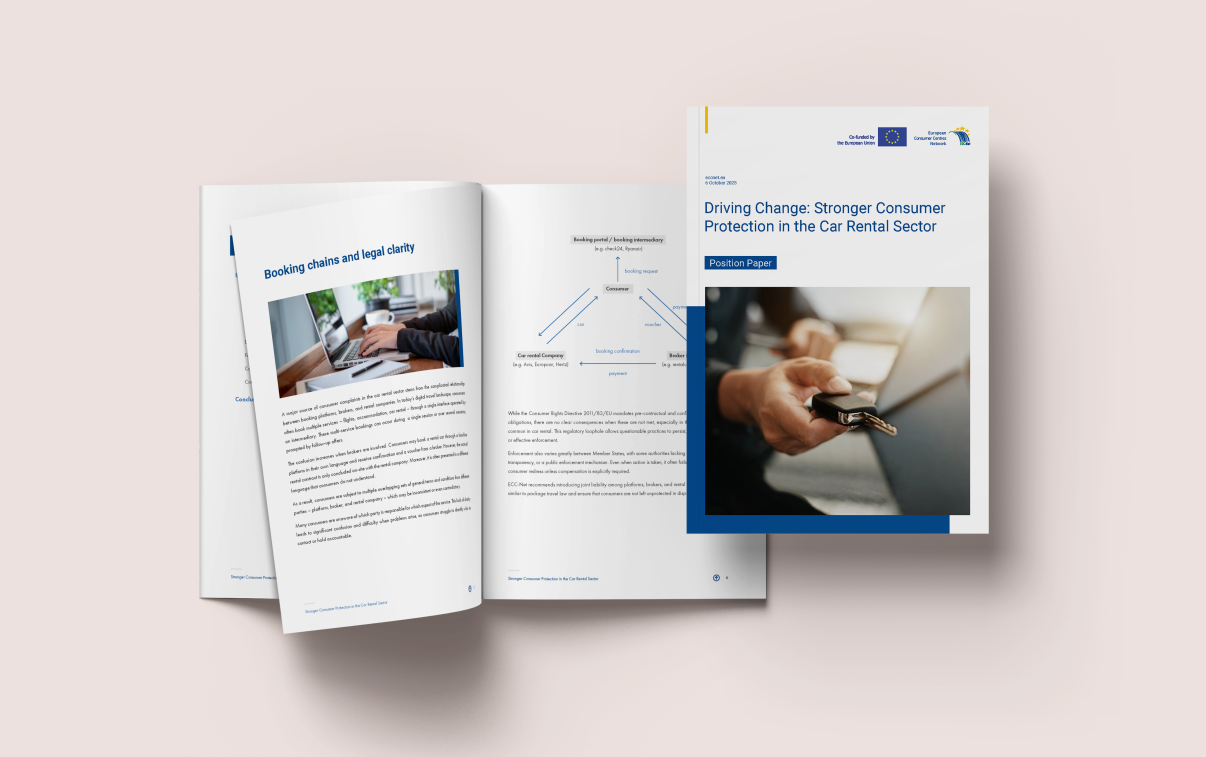
Although millions of consumers in the EU rely on rental cars to travel, they often encounter various challenges at the rental desk and after returning the car. The Network of European Consumer Centres (ECC-Net) has recently published a position paper addressing common issues in the car rental sector, emphasising the need to ensure greater transparency and consistency within the sector.
Common issues with car rentals
In 2025, ECC-Net received 6,016 complaints related to car rental companies. These cases highlight recurring issues - yet they represent only the visible part of a much larger and persistent challenge in the sector. Although some rental companies have pledged improvements, these commitments are applied inconsistently, while others fail to take action altogether.
Therefore, many of the issues persist, such as:
- Complexity with multiple parties in the booking process, shifting their responsibility
- Confusing insurance offers and hidden fees
- Disproportionate impact of cancellation and no-show policies
Complexity with multiple contract parties
Consumers can easily book a rental car and are often encouraged to do so when they book a flight or accommodation. However, resolving an issue can become complicated when multiple parties are involved in the booking process. In this situation, determining which party should address the problem becomes an additional challenge. Moreover, the responsibility to resolve an issue or provide a refund is often shifted to another party.
Confusing insurance offers and hidden fees
When consumers arrive at the rental desk to pick up their car, they are often pressured into signing an insurance contract that had already been concluded at the time of booking or into purchasing unnecessary additional insurance. Additionally, consumers are confronted with surcharges that have already been paid in advance. Sometimes, the car rental company even threatens to withhold the car if the consumer refuses to pay.
Disproportionate impact of cancellation and no-show policies
In the event of a cancellation or no-show, some intermediaries retain the entire amount paid by the consumer, even though the consumer has not yet concluded a contract with the rental car company. Furthermore, consumers affected by flight delays may hasten themselves to the rental desk only to find out that the no-show policy has been applied and the rental car is no longer available. In cases where the consumer booked directly from the rental company, the car should be reserved for the consumer until they arrive.
Want to know more?
The three highlighted issues are only part of the challenges consumers face in the car rental sector. ECC-Net also points to wider concerns such as hidden fees, damage disputes, excessive fuel and administrative charges, weak complaint handling, and poor contract transparency. The newly released position paper sheds light on these practices and, through careful analysis, puts forward concrete recommendations to address the difficulties consumers encounter when renting a car.
Read the full position paper here: Driving Change: Stronger Consumer Protection in the Car Rental Sector | European Consumer Centers Network.