


European Energy Labels — Good for the Environment and Your Wallet
Energy labels were first introduced almost 30 years ago. They have since helped consumers opt for products that consume less energy. This is a perfect example of a win-win situation that results in ecological and economic benefits. First, consumers save money. Second, manufacturers are encouraged to innovate and develop more energy-efficient and competitive technologies. A positive side effect is that these efforts benefit the environment.
The basic idea is simple. Energy labels rank appliances on a scale from A to G, depending on how much energy they consume. Class A (green) appliances are the most energy efficient, while Class G (red) appliances consume the most energy.
The energy label must be clearly displayed on the packaging of each product sold in the EU — no matter if it is sold at a physical point of sale or online — except for second-hand products.
Over the past few decades, the increasing competition amongst environmentally friendly companies led manufacturers to introduce new subcategories (such as A+, A++, and A+++) to differentiate themselves from their competitors.
However, this development and the associated lack of transparency made it more complicated for consumers to choose the most energy-efficient product.
To solve this problem, the EU launched a new generation of energy labels that reintroduce the simpler and more consumer-friendly ‘A to G scale’ in 2021. The new ‘A-label’ is reserved for future products that will be even more energy efficient than the current generation.
This new rating system applies to the following product groups:
- Refrigerators
- Dishwashers
- Washing machines
- Televisions
- Light bulbs and lamps
So, before purchasing any of these products, make sure you know how to recognise a rescaled product:
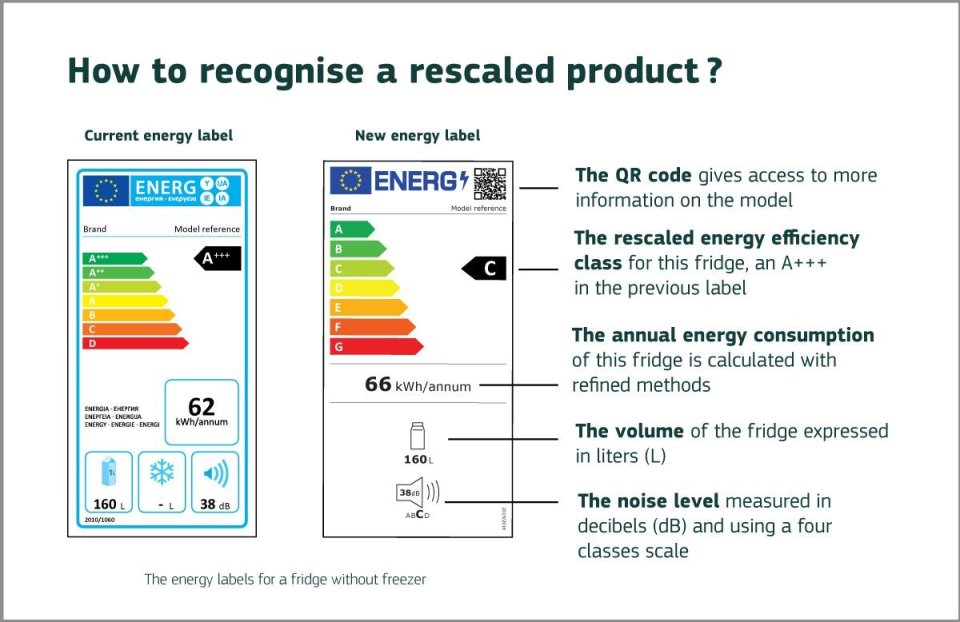
This new energy label’s most distinguishing feature is its QR code. If you scan the code with your smartphone, you will receive further information about the product, such as dimensions, special features, or test results.
This ensures that EU energy labels remain up-to-date in the digital age.
In addition to the new EU energy labels, new regulations on eco-design have entered into force on 1 March 2021. Their main purpose is twofold: they should reinforce the consumer’s right to repair products and reduce the waste of electrical and electronic equipment. Manufacturers or importers are now obliged to provide professional repairers with a larger range of spare parts (such as motor pumps and washing drums) for at least 7-10 years after a product line has been phased out. On top of that, manufacturers should make certain spare parts available to end users for several years after a product is taken off the market. The maximum delivery time for all these parts is 15 working days after an order has been placed.
Taken together, these measures contribute to a more sustainable electrical industry and encourage more responsible consumption, both of which will promote protection of the environment.
More information
Learn more about European energy labels on the websites listed below.