

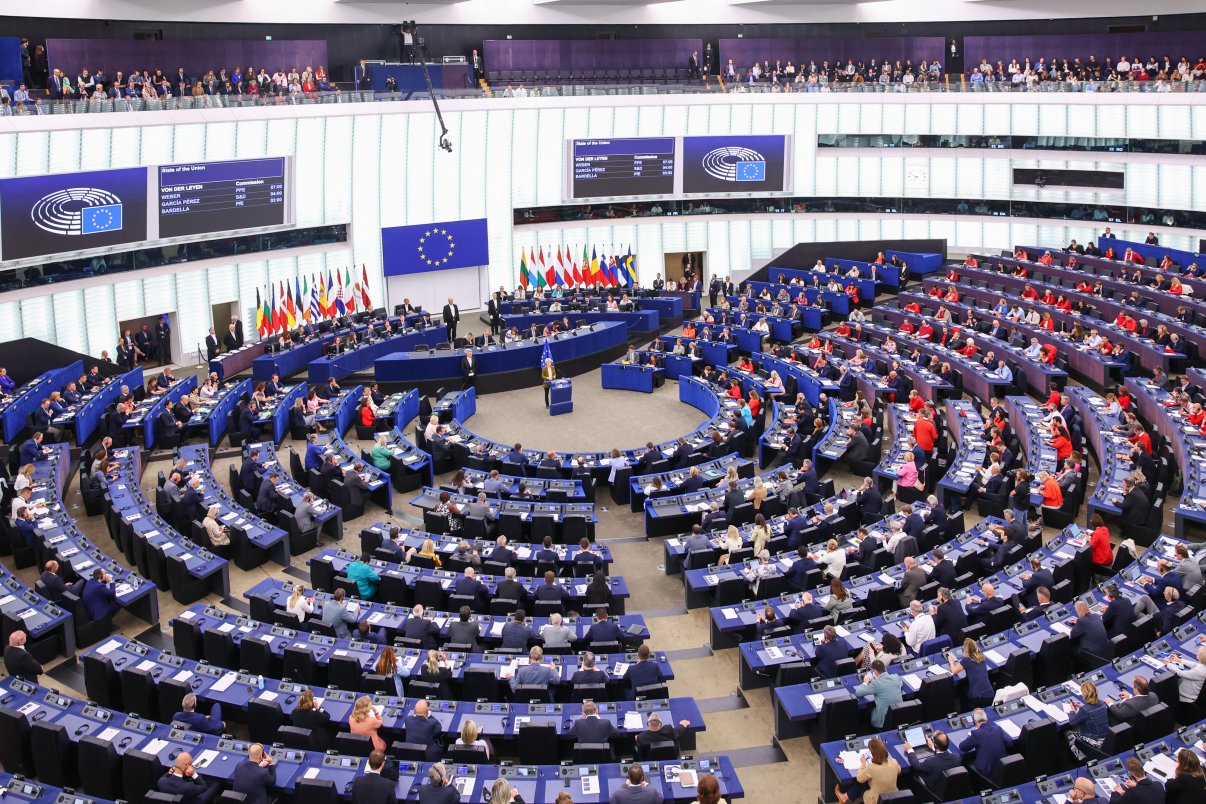
SOTEU 2025: Europe's Moment of Independence
On 10 September 2025, Ursula von der Leyen addressed the European Parliament. In her State of the European Union (SOTEU) speech, the President of the European Commission acknowledged how Europeans feel the impact of current global events and stated that this is Europe’s ‘moment of independence’ – a call for greater unity, competitiveness and resilience in these uncertain times.
Key focus areas for the upcoming years
Ms. von der Leyen's address ranged widely, touching on Europe's security, competitiveness, and industrial strength. Defence featured prominently, alongside the single market, digital transformation, and the shift to a cleaner economy. To become more independent, Europe needs to be more competitive. This means making business in Europe easier and encouraging consumers to buy European products.
Less administrative burdens for European companies
The Commission wants to make it easier for businesses to operate across European borders, especially in the energy, telecommunications, and finance sectors. The Commission's proposals aim to reduce bureaucratic costs and simplify rules for European companies.
Introduction of a digital euro
The digital euro aims to simplify payments for consumers and businesses throughout Europe. It is a digital version of cash that will be issued by the European Central Bank. Unlike other types of digital currency, the digital euro represents public money. It will provide a dependable alternative for everyday transactions, whether online or in physical stores. Banks would be required to provide a free digital euro account to anyone who wants to use it. With the digital euro, making payments across Europe will be easier, and it will allow for transactions without an internet connection.
Promotion of European products
Two key focus areas of the European Commission will be artificial intelligence and clean technology. According to Ms. von der Leyen, these sectors are crucial for Europe's future independence. For example, investments in clean tech are supposed to boost the local production of electric cars. Another important goal of the Commission is to strengthen the position of farmers and ensure fair prices for their food.
- Made in Europe
To encourage European industrial leadership in the clean tech sector, a 'Made in Europe' criterion will be introduced in public procurement. The Commission also wants to set strong incentives for partners to buy European. - Buy European Food campaign
Ms. von der Leyen announced that the Commission's promotion budget will be boosted to launch a new 'Buy European food' campaign.
Plans for a circular economy
With an Industrial Accelator Act and the Global Gateway, the Commission wants to speed up the shift towards cleaner technologies and a circular economy. These plans focus on the creation of more durable products, easier repair options, and less waste.
Media and big tech
The president of the European Commission has announced a media resilience programme, aiming to tackle the root causes of misinformation. This will include initiatives for media literacy and increased funding for traditional media.
In a note on Europe's relations with the US, Ms von der Leyen stressed that Europe will set its own standards for environmental and digital regulations. Furthermore, she voiced concerns about the impact of major tech companies' algorithms on children, highlighting the need for parents to retain control over their children's education. Depending on the advice she receives by the end of the year, Europe may consider following Australia's lead by introducing age restrictions.
What does this mean for consumers?
Alongside Europe's push for industrial strength and competitiveness, Ursula von der Leyen also outlined initiatives that are meant to improve consumer protection and everyday life. The Commission is preparing a proposal for a Digital Fairness Act, currently under public consultation, to tackle issues like manipulative online design (dark patterns), unclear subscription practices, and unfair marketing. A new Action Plan against cyber bullying is also in the works to protect children and young people online.
These efforts show that Europe’s future competitiveness is envisioned not just in economic terms, but in fairness, transparency, and trust for consumers.
The ECC Network closely follows consumer protection developments and provides insights into issues consumers encounter in cross-border interactions. For example, ECC-Net recently shared its views on the new EU Consumer Agenda.
The road ahead
Turning these ambitions into practice will take time, and agreement among 27 Member States is not guaranteed. Still, the direction is set: a Europe that is more competitive, less dependent on outside suppliers, and more confident in shaping the digital and industrial standards of tomorrow.
Want to know more?
Watch the speech and read more on State of the Union 2025 - European Commission
Read ECC-Net's policy paper on the new EU Consumer Agenda
Photo credits
- Source & Producer: EC Audiovisual Service
- Photographer: Christophe Licoppe
- Copyright: European Union, 2025