

Air Passenger Rights
ECC-Net notes an urgent need for revision of Air Passenger Rights Regulation (EU) 261/2004. In ECC-Net's experience, has become increasingly difficult to apply the rights foreseen by the EU legislation and case law of the Court of Justice of the European Union (CJEU) through amicable agreements.
Urgent Need to Revise EU Air Passenger Rights Regulation (261/2004)
In ECC-Net’s experience, it is becoming increasingly difficult to ensure the application of rights as foreseen by EU legislation and CJEU case law through amicable agreements. Recourse to justice is no longer just a last resort; it is often the only option for consumers. Thus, the rise of private claims companies specializing in airline complaints is not surprising.
To effectively implement air passenger rights, the following suggestions should be considered. Most of these measures were included in the draft revision of Regulation 261/2004 submitted to the European Parliament in 2013 but remain unresolved. Addressing these deficiencies in Regulation 261/2004 should be a matter of priority.
When facing cancellations, delays, or denied boarding, consumers primarily seek good information and assistance. They want to know what is happening and how quickly they can reach their final destination. Compensation is not their primary concern when they board a plane.
We strongly recommend simplifying the regulation in its revision. The current regulation, interpreted through extensive case law, is challenging for ECCs and enforcement officers to apply. A clearer, simplified regulation would help consumers understand their rights better and reduce disputes between parties.
The cases handled by ECC-Net regarding air passenger rights extend beyond Regulation 261/2004, encompassing luggage issues, intermediary problems, and price comparison websites. New contracts, such as multimodal transport agreements—which are becoming more prevalent in these sustainable times—are not covered by the current regulation. No-show clauses and airline insolvencies also pose challenges for passengers. For these emerging issues in the air passenger rights sector, ECC-Net often remains the only body providing cross-border assistance free of charge.
Therefore, ECC-Net would like to share its experience by broadening the scope of the regulation to encompass all aspects of air passenger rights.
- Airlines should be required to offer rerouting not only on their own fleet but also on other airlines or transport modes, if it allows the consumer to reach their destination earlier and under comparable transport conditions.
- It is essential to ensure that passengers are well protected in cases of intermodal transport, with clear rules regarding the application of rights. For example, there should be clarity on the rights of air passengers versus train passengers when one leg of the journey is by train.
- Airlines should be required to immediately and accurately inform passengers about their rights at the airport, with effective enforcement of this information duty.
- Airlines should apply CJEU case law (e.g., the Nelson case) and guarantee identical rights in the event of flight cancellations or long delays, particularly concerning the amounts and scales of compensation.
Under the current rules, passengers who withdraw from their contract after their flight has been delayed by at least 5 hours are not entitled to compensation. In contrast, passengers who opt for a refund instead of rerouting in the event of a cancellation are entitled to compensation.
A harmonized approach to no-show policies across the EU should be considered to avoid differences in the application and understanding of consumer rights based on the country of residence or competent court.
Clarify uncertainties under Article 7:
- Double compensation
Should passengers receive double compensation if their alternative flight is delayed or cancelled again? - Route calculation
How should the route be calculated if an incident occurs during a multi-segment flight? Specifically, what place of departure should be used for calculating compensation? The CJEU ruling in Case C-559/16 (paragraph 29) does not provide a clear answer to this question, as it primarily addressed a different issue.
Additional recommendations:
- Contact information
Require airlines to provide their full contact information and claim forms on their websites to facilitate easy contact in the event of a claim. Consumers should always receive a copy of any message sent to the airline. - Language accessibility
Airlines should be accessible in the language of the booking process. While airlines often offer websites in multiple languages, customer service is frequently available in only a few. If an airline cannot provide after-sales service in the language of the website used for booking, this should be clearly indicated before the booking is completed. - Time limits
Impose time limits for consumers and response times for airlines to encourage airlines to improve their efficiency in handling and tracking consumer complaints, and to streamline compensation procedures. - Definition of extraordinary circumstances
Define what constitutes "extraordinary circumstances" and list the events that may justify the non-payment of compensation by airlines. - Role of NEBs
Clearly define the role of National Enforcement Bodies (NEBs) with respect to passengers and involve them in the settlement of disputes, especially given their expertise in extraordinary circumstances. - Complaint forwarding
Oblige NEBs to forward complaints to the competent NEB, as passengers are often unaware of the principle of incident-based jurisdiction. - Sanction mechanism
Enhance NEB effectiveness by implementing a common and dissuasive mechanism for sanctioning companies that fail to respect passenger rights and ensuring communication about sanctions taken. - Improved communication
Improve communication and cooperation among airlines, consumer organizations, Alternative Dispute Resolution (ADR) bodies, and NEBs to clarify the role of each party to consumers, facilitate complaint resolution, and exchange data on recurrent issues. - ADR/ODR evaluation
Evaluate and follow up at the EU level on the effectiveness of current ADR/ODR legislation. Given that ADR coverage and trader involvement do not seem to meet set targets, it is essential to ensure that each Member State provides ADR in the air passenger rights sector to address individual consumer disputes. The recent directive on consumer ADR and regulation on consumer ODR offer incentives for ADRs. ADR must remain a swift, easily accessible, and, if possible, free option for consumers to ensure it remains viable for passengers.
In order to maximize the potential of ADR in the air passenger rights sector, ECC-Net offers the following conclusions and recommendations.
Legal framework for price comparison websites and booking intermediaries
To secure the best deals, consumers increasingly rely on online price comparison websites and booking platforms. The ECC-Net has observed a rise in complaints related to both types of intermediaries.
Price comparison websites
Comparing ticket prices before booking is becoming increasingly challenging, sometimes even impossible, as each intermediary determines what to include in their reference price.
To ensure transparent consumer information and promote fair competition among air carriers, price comparison tools, and booking intermediaries, the following suggestions should be considered:
- Inclusion of all costs
All unavoidable and foreseeable price elements should be included in the headline price to facilitate accurate comparison between operators. Optional price supplements should be clearly displayed next to the headline price at every step of the booking process. The headline price should include:- The ticket price.
- All unavoidable and/or foreseeable service fees, including administrative fees, luggage charges (refer to the section below for luggage prices), seat selection, and credit card fees in countries where such charges are permitted. Even if a consumer might receive a discount later due to their chosen payment method, these costs should be indicated.
- A breakdown of the final price into different categories, including taxes, clearly indicating refundable taxes.
- Ticket flexibility information
Price comparison websites should clearly indicate whether tickets are flexible, refundable, or subject to other conditions. They should use the terminology provided by the airline to ensure that consumers can verify the transport conditions as advised by these websites.
Booking Intermediaries
Booking intermediaries often present themselves as acting on behalf of the consumer and may charge a service fee for their services. Therefore, it is suggested that they should be bound by minimum service standards to ensure adequate consumer protection.
- Transparency of ticket and service information
Booking intermediaries should be required to immediately and accurately inform passengers about the type of tickets and services they are purchasing. This includes details about pricing (as outlined above), whether tickets are flexible or non-flexible, and any special conditions or restrictions imposed by airlines. For instance, airlines may have strict rules regarding ID controls or restrictions on minors traveling alone. - Explanation of membership/premium systems
Any "membership" or "premium" systems offered should be clearly explained, with detailed conditions provided. - Disconnection of flights
Booking intermediaries should clearly inform passengers about the implications of purchasing disconnected flights. This includes the impact of schedule changes, delays, or cancellations on the rest of the journey and the passenger’s rights to assistance or compensation. They should also inform passengers about practical consequences during travel, such as luggage not being checked in until the final destination. - Contact information and claim forms
Booking intermediaries should provide their full contact information and claim forms on their websites to facilitate easy contact in the event of a claim. Consumers should always receive a copy of any message sent to the intermediary. - Language accessibility
Booking intermediaries should be accessible in the language used during the booking process. While airlines often offer websites in multiple languages, customer services are frequently available in only a few. If an intermediary cannot provide after-sales service in the language of the booking website, this should be clearly indicated before the booking is finalized. - Intermediary responsibilities
Booking intermediaries should act on behalf of passengers in the following situations:- Schedule changes or flight disruptions
The intermediary should promptly pass all relevant information to the consumer. - Ticket Changes
There should be a right to correct spelling errors in passengers’ names, covering mistakes made by consumers and changes made during the booking process by intermediaries. - Difficulty reaching the airline
Intermediaries should assist if consumers have trouble contacting the airline directly. - Refund requests
Intermediaries should facilitate refunds in cases where airlines require issues to be handled through the intermediary.
- Schedule changes or flight disruptions
- Time limits for responses
Impose time limits for both consumers and booking intermediaries to encourage efficient handling and tracking of complaints and to streamline refund procedures. - Immediate replies and forwarding requests
Booking intermediaries should immediately respond to consumer requests or forward them to the airline if the flight is imminent. - Fee restrictions
Prohibit booking intermediaries from charging fees for forwarding a consumer’s cancellation request or for refunds issued by airlines. It is not the passenger’s choice to handle these issues indirectly through intermediaries. - Enhanced communication and cooperation
Improve communication and cooperation among airlines, booking intermediaries, consumers, consumer organizations, ADR bodies, and NEBs to clarify each party’s role, facilitate complaint resolution, and enable data exchange on recurrent issues. - Booking process history
Compel air carriers, online travel agencies, and other intermediaries to provide consumers with a history of their booking process upon request.
Protection against airlines insolvencies
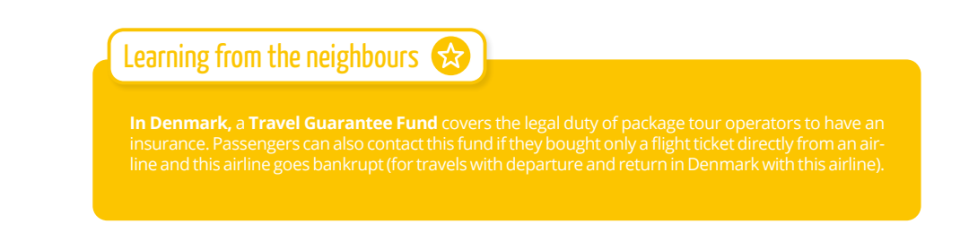
In its communication COM(2013) 129 final, the European Commission committed to fostering cooperation among the competent authorities of Member States, monitoring their licensing oversight under Regulation 1008/2008, and evaluating the need for legislative measures to ensure passenger protection in the event of airline insolvency.
For several years, the ECC-Net has highlighted issues related to airline insolvencies, and recent experiences reveal that consumer protection in these cases remains inadequate. With predictions of increased insolvencies in 2020, addressing this issue has become an urgent priority.
Definition and harmonization of cabin luggage dimensions and weight
The pricing of airline tickets is becoming increasingly opaque, as carriers have the freedom to define what is included in their fares. This often makes price comparison difficult unless consumers meticulously review each step of the booking process to identify additional charges. One notable issue is the pricing of hand luggage, which is sometimes excluded from basic fare tickets.
The problem has been addressed in Italy, where the Competition Authority (AGCM) imposed penalties on Ryanair (€3 million) and Wizz Air (€1 million) for their cabin luggage policies. AGCM stated, "The changes to the rules for transporting large hand luggage constitute an unfair commercial practice, misleading consumers about the true price of the ticket by not including a significant component of the air transport contract—the large hand baggage—in the basic fare."
However, this perspective represents only one country's enforcement authority. There is no harmonized or unified understanding across the EU.
To enable consumers to make genuine price comparisons regarding airfares, including cabin luggage, and to ensure fair competition among operators, the following should be established:
- Definition and harmonization
Define and harmonize what services are included in the minimum fare across the EU. - Transparency
Clearly state at the beginning of the booking process which services are included in the minimum fee. - Passenger rights
Ideally, all passenger rights should be codified in a single location to allow consumers to easily understand and research their rights.