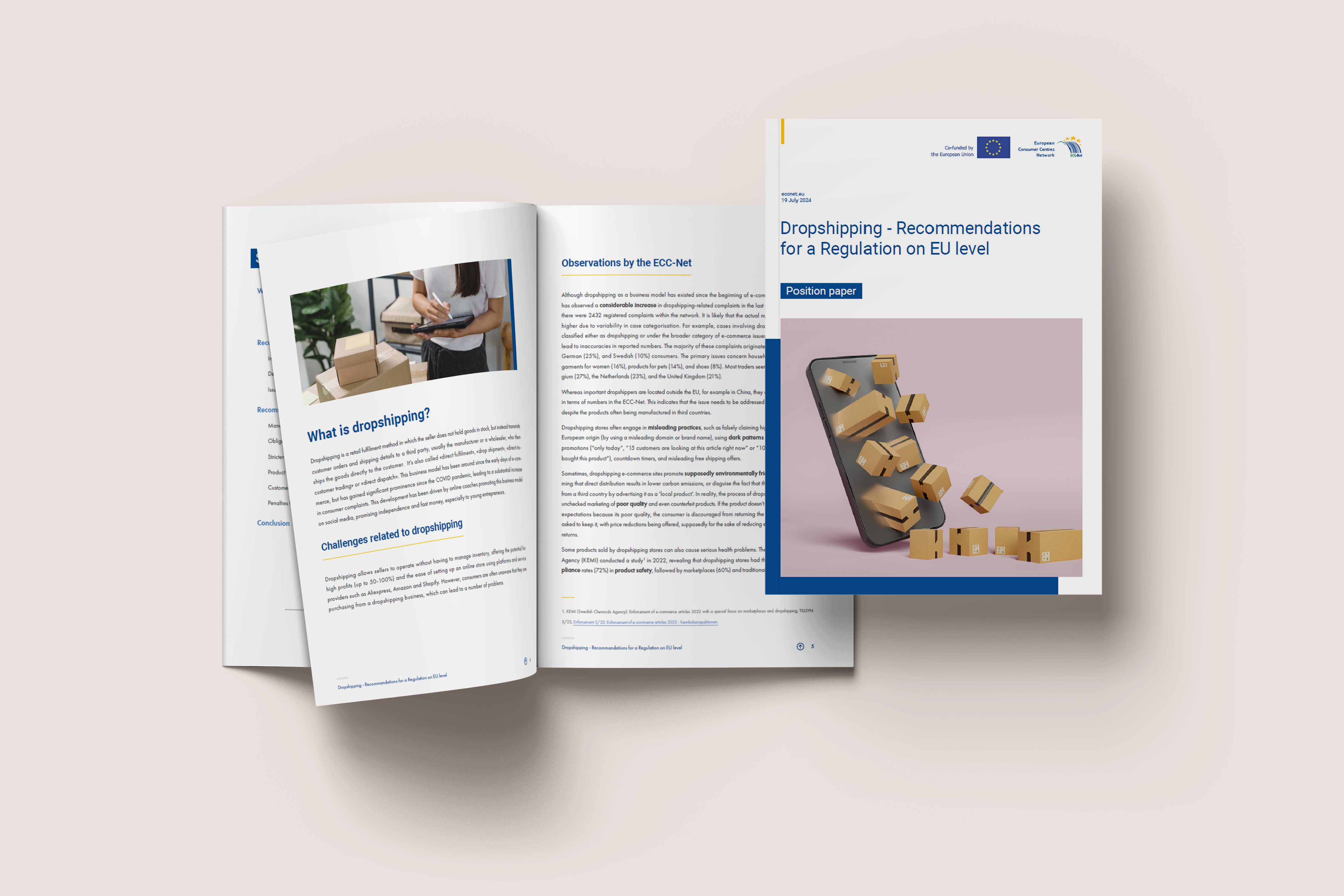
Dropshipping - Recommendations for a Regulation on EU Level
The European Union has been consistently enhancing consumer rights in e-commerce over the past few decades. While consumers are well-protected against unfair business practices in many respects, the European Consumer Centres Network (ECC-Net) has identified a range of issues linked to the increasing prevalence of 'dropshipping' companies. Therefore, ECC-Net has published a policy paper that addresses the challenges connected with dropshipping.
What is dropshipping?
Dropshipping is a retail fulfilment method in which the seller does not hold goods in stock, but instead transmits customer orders and shipping details to a third party, usually the manufacturer or a wholesaler, who then ships the goods directly to the customer. It’s also called «direct fulfilment», «drop shipment», «direct-tocustomer trading» or «direct dispatch». This business model has been around since the early days of e-commerce, but has gained significant prominence since the COVID pandemic, leading to a substantial increase in consumer complaints. This development has been driven by online coaches promoting this business model on social media, promising independence and fast money, especially to young entrepreneurs.
Challenges related to dropshipping
Dropshipping allows sellers to operate without having to manage inventory, offering the potential for high profits (up to 50-100%) and the ease of setting up an online store using platforms and service providers such as Aliexpress, Amazon and Shopify. However, consumers are often unaware that they are purchasing from a dropshipping business, which can lead to a number of problems.
Observations by the ECC-Net
Although dropshipping as a business model has existed since the beginning of e-commerce, the ECC-Net has observed a considerable increase in dropshipping-related complaints in the last years. In June 2024, there were 2432 registered complaints within the network. It is likely that the actual number is significantly higher due to variability in case categorisation. For example, cases involving dropshipping might be classified either as dropshipping or under the broader category of e-commerce issues. This variability can lead to inaccuracies in reported numbers. The majority of these complaints originate from French (46%), German (25%), and Swedish (10%) consumers. The primary issues concern household furniture (27%), garments for women (16%), products for pets (14%), and shoes (8%). Most traders seem to be based in Belgium (27%), the Netherlands (23%), and the United Kingdom (21%).
Whereas important dropshippers are located outside the EU, for example in China, they are not yet significant in terms of numbers in the ECC-Net. This indicates that the issue needs to be addressed at a European level, despite the products often being manufactured in third countries.
Dropshipping stores often engage in misleading practices, such as falsely claiming high product quality or European origin (by using a misleading domain or brand name), using dark patterns such as fake scarcity promotions (“only today”, “15 customers are looking at this article right now” or “10 customers have just bought this product”), countdown timers, and misleading free shipping offers.
Sometimes, dropshipping e-commerce sites promote supposedly environmentally friendly products, claiming that direct distribution results in lower carbon emissions, or disguise the fact that the product is shipped from a third country by advertising it as a ‘local product’. In reality, the process of dropshipping involves the unchecked marketing of poor quality and even counterfeit products. If the product doesn’t match the consumer’s expectations because its poor quality, the consumer is discouraged from returning the product and instead asked to keep it, with price reductions being offered, supposedly for the sake of reducing emissions by avoiding returns.
Some products sold by dropshipping stores can also cause serious health problems. The Swedish Chemicals Agency (KEMI) conducted a study in 2022, revealing that dropshipping stores had the highest non-compliance rates (72%) in product safety, followed by marketplaces (60%) and traditional online stores (39%).
Recurring complaints from consumers
The problems mentioned above have been identified through the analysis of numerous complaints handled by the ECC-Net. Consumers have reported various issues with dropshipping companies to the ECC-Net, including the following specific examples:
Information and contact issues
- The imprint on websites of dropshipping merchants is incomplete or missing.
- In some cases, there are discrepancies between the cancellation policy and the terms and conditions regarding the return policy. This causes confusion among consumers about which information is correct.
- Many traders don’t provide any customer service at all.
- Traders are often registered in Europe, but the registered address is sometimes just a PO box. This complicates legal enforcement, as legal notices cannot be delivered to a PO box, so a judgment against these companies therefore can’t be executed.
- Some websites use fake reviews and fake trustmarks or other labels.
- The company is a fake shop (often websites go offline after the order is placed).
Delivery issues
- It is common that orders have a very long delivery time (despite the information on the website), and in some cases, consumers are repeatedly told that the delivery has been postponed.
- In some cases, although an order can still be placed, it is possible that the goods are already out of stock at the actual supplier and can’t be delivered. The purchase price is still charged immediately.
- Some sellers don’t inform about additional costs for import VAT and customs fees.
- Invoices sometimes don’t match the order that was delivered.
Issues with returns
Sometimes a previously unknown company is named as the sender on the parcel. As a rule, these are pure logistics and shipping service providers who merely take over the delivery to the customer on behalf of the dropshipper. This misleads customers into believing that they can also use this address as a return address. However, the parcel is not accepted there or is not accepted as a proper return.
- The delivered articles are of poor quality, don’t look like they were advertised online and often have defects. Consumers then often can’t make use of their legal guarantee, often confused by the traders with the right to withdrawal.
- The cancellation policy often does not include information on where to return products in case of withdrawal by the consumer; sometimes the return address has to be requested from the store.
- The right of withdrawal is not accepted by the shops or can’t be exercised (the trader only offers a discount or a new product, the trader doesn’t provide a return address or refuses the withdrawal altogether).
- Return costs to third countries often exceed the value of the product itself. There may also be unexpected customs fees.
- Returns often don’t arrive when they are sent to the specified return address in a third country (some merchants don’t collect them or discard them).
- Problems with payment providers often arise in relation to dropshipping companies, because the online shops don’t inform the payment providers about returns from consumers. As a result, the consumers continue to receive payment reminders from these providers.
ECC-Net's recommendations
There are currently no specific rules for drop shipping companies in most Member States or at European level. Therefore, the general rules for e-commerce apply. These should be supplemented by further rules specifically aimed at dropshipping companies in order to address the above-mentioned issues by filling the legal gaps that currently exist.
Conclusion
The rising number of dropshipping online stores presents significant challenges for consumer protection. By implementing specific regulations and ensuring transparency and compliance, the EU can strengthen consumer rights and protect against the risks associated with dropshipping. These measures will promote a safer and more trustworthy e-commerce environment