ADR in the Nordic and Baltic Countries

23 May 2023

Alternative Dispute Resolution schemes in the Nordic and Baltic countries have a lot in common and build on the same principles and ideas. However, it is also clear there are differences in procedures and working methods. This comparative study aims to gain insight in the similarities and differences between ADR landscapes in Denmark, Estonia, Finland, Iceland, Latvia, Lithuania, Norway and Sweden.

Introduction

The Nordic and Baltic countries have a lot in common in alternative dispute resolution (ADR). Not only does the same EU regulation, the ADR directive, apply to all countries' ADR schemes but the countries also build on the same ideas and thinking on how to organize and deliver out-of-court dispute resolution. 

However, looking closer it is clear that there are also differences when comparing ADR in the Nordic and Baltic countries. The number of notified ADRs differs and there are different procedures and working methods. Furthermore, all countries have their own different limitations preventing them from offering consumers a full ADR coverage in reality. 

We have done this comparative study of ADR in the Nordic and Baltic countries to gain more insight into the similarities and the differences in the ADR landscapes in our countries. The reasoning behind doing this comparative study is three folded:

  1. We want to provide our Network, the ECC-Net, with better understanding on how ADR works in the Nordic and Baltic countries, thereby qualifying the work we do in the Network with assisting consumers in cross-border disputes.
  2. The study is also done to provide information to the European Commission, Nordic and Baltic ministries and other stakeholders. Information that can be used as insight and inspiration during the expected revision of the European ADR and ODR legislation.
  3. Finally, it is also the aim of the study to provide national ADR competent authorities and others with knowledge and data about the ADR schemes in this region. This way we would like to help create a better basis for each of our countries evaluation of national ADR schemes – “Learn from your neighbours” is often the best and easiest way to find inspiration for improvements.

Observations

It is not as such the scope of this study to deliver recommendations, but the discussions between our centers during an ADR workshop hosted by ECC Latvia in December 2022 with the purpose of getting in depth understanding of each countries ADR schemes nevertheless revealed a few important observations. 

In general, trader engagement in ADR and trader compliance with decisions are very strong in the Nordic and Baltic region. There are several reasons for this: 

Some countries specifically mention that ADR bodies are well-reputed by traders and therefore even the non-binding decisions from an ADR are often accepted. Other ADR entities ensure trader engagement and compliance due to their binding decisions or the also well-used type of decision where the trader is bound by the decision if no reaction from the trader. Such decisions ensure that traders that are not actively disputing a decision are bound by such decision. As such, this type of decision does not prevent the traders from taking a dispute to court, but at the same time it safeguards the value of an ADR decisions from the consumers perspective in the situations where a trader simply ignores the ADR procedure. 

Very often consumers from other countries have difficulties using the national ADR entities. This is the situation in all countries. Language barriers, difficulties in understanding procedures and ADRs' non-acceptance of cases where applicable law are not national law is some of the most often mentioned reasons why consumers from other EU countries have difficulties taking advantages of the ADR schemes. 

The ECC's in all Nordic and Baltic countries work in different ways to support the national ADR schemes. From supporting ADRs via active participation in decision-making and interpretation of EU law and practice to concrete assistance to consumers from other EU countries in order for them to navigate through the complaint procedure at the different ADRs. The services provided by ECCs varies from country to country and it seems relevant to consider if such services towards ADRs and consumers can be aligned and better supported to strengthen ADR in cross-border disputes. 

ECC Denmark, ECC Estonia, ECC Finland, ECC Iceland, ECC Latvia, ECC Lithuania, ECC Norway, ECC Sweden

Survey 

The comparative study is based on data gathered by our centers in October and November 2022. The data was further qualified in discussions that were carried out at the joint workshop in Riga. 

With this report, we provide a unique and easily accessible comparative study of ADR schemes in the Nordic and Baltic region. The data is not meant to be an exhaustive presentation of countries included in this study; neither does it resemble the official ADR reports produced by the national competent authorities. 

Instead, this study is looking into some of the most important characteristics of the ADR schemes from the practitioners’ perspective, for example the different limitations that can hinder consumers from turning to the ADRs. The focus in this study is also on ADR complaint handling barriers linked to cross-border disputes, as the ECC-Net's main task is to assist consumers that are involved in a cross-border dispute with a trader. 

Each dataset is accompanied by a few comments and, where relevant, we have also provided some insights that cover in-depth information on some of the interesting findings, and/or some good examples identified in one of the participating countries.

Country-specific information on ADR

    • Iceland
      Number of notified ADRs: 6 
      Funding: public and private
    • Norway
      Number of notified ADRs: 12
      Funding: public and private
    • Sweden
      Number of notified ADRs: 7
      Funding: public and private
    • Finland
      Number of notified ADRs: 3
      Funding: public and private
    • Denmark
      Number of notified ADRs: 26
      Funding: public and private
    • Estonia
      Number of notified ADRs: 4
      Funding: public and private
    • Latvia
      Number of notified ADRs: 6
      Funding: public and private
    • Lithuania
      Number of notified ADRs: 4
      Funding: public

    The number of ADR entities varies and the Danish ADR scheme has considerably more ADRs than the other countries. In addition, the number of complaints varies considerably from country to country, from 553 cases in Latvia to 24,763 cases in Norway. In all countries ADR entities are both publicly and privately funded, except Lithuania. ADR entities in Lithuania are fully financed by public means. General (residual) ADR entities are established in all countries and all residual ADR entities are public ADRs.

    #overview–nordic-and-baltic-adr

    Copied to clipboard!
    • Denmark: 14,090 
    • Estonia: 3,087 
    • Finland: 6,972 
    • Iceland: 994 
    • Latvia: 553 
    • Lithuania: 9,220 
    • Norway: 24,763 
    • Sweden: 21,630

    #total-number-of-complaints

    Copied to clipboard!
  • Biggest ADRs based on number of complaints (2021):

    • Allmänna reklamationsnämnden (ARN) / The National Board for Consumer Disputes (Sweden): 19,699
    • Valstybinė vartotojų teisių apsaugos tarnyba / State Consumer Rights Protection Authority (Lithuania): 8,557
    • Forbrukertilsynet / The Consumer Authority (Norway): 8,072 

    #insights

    Copied to clipboard!

ADR accessibility 

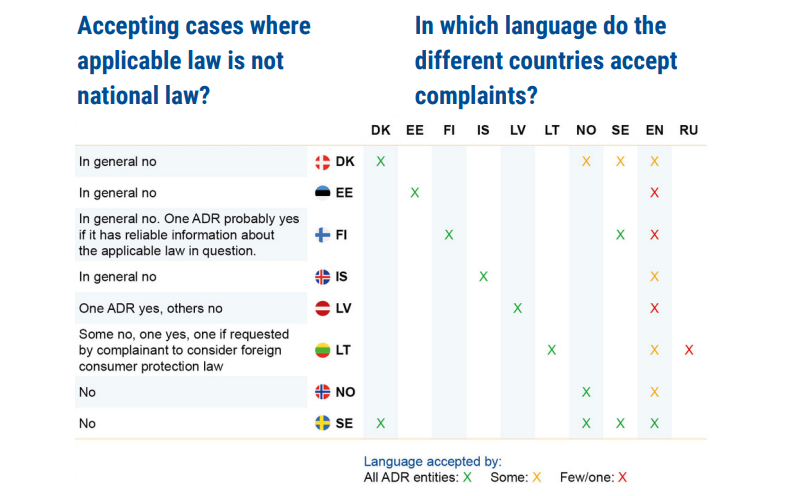
English is the most broadly accepted foreign language and can be used in many ADR entities in the Nordic and Baltic countries. But in all countries there are ADR entities that require complaints to be filed only in official national language(s). 

Almost all ADR entities only accept cases where the applicable law is the national law. In all countries it will often not be possible to file a complaint at an ADR entity if the trader is not established in the same country as the ADR. 

Trader engagement is mainly voluntarily but most ADRs in the Nordic and Baltic countries can make decisions regardless of whether the trader participates or not. This way the procedural rules give traders a strong incitement to participate in ADR. 

Although all sectors seem to be covered in most countries there are in reality some circumstances that limit the coverage in reality: Full ADR coverage in reality is reduced by monetary thresholds in most countries, as well as due to cases being rejected if the trader is not established in the country of the ADR, or because the applicable law is not the national law.
Image
ADR accessibility

Country-specific information on ADR accessibility

    • ECC Denmark 
      In general no, but many ADRs have an exception: If the case has a greater attachment to Denmark than the country of establishment, or if the parties have agreed upon this. One ADR (the NEB) accepts cases against airlines established in other countries. 
    • ECC Estonia
      Two insurance sector ADRs accept cases against insurers located in another EU country if they have received consent from the insurer that the matter can be resolved in the conciliation body. General ADR (Consumer Disputes Committee) accepts complaints against a trader from another EU country if the trader states in their terms and conditions that the competent out-of-court body is Consumer Disputes Committee. 
    • ECC Finland
      Two ADR entities accept, but they require the trader to send its response in Finnish or Swedish. However, if the consumer's complaint is based on the EU Regulation 261/2004 (air passenger rights), the trader is allowed to respond in English.  
    • ECC Iceland
      In general, they do not and many of them would dismiss such cases. However, some ADR´s have not totally dismissed that possibility as they have not received cases from traders established in another country to this point. 
    • ECC Latvia
      No, except from one ADR (insurance) that handles complaints of clients of members of the Latvian Insurers Association, as well ombudsman handles complaints about an insurer who is not a member of the Association of Latvian Insurers, but which has the right to provide insurance services in the Republic of Latvia, if the particular insurer agrees in writing to the procedure for handling the complaint. 
    • ECC Lithuania 
      One ADR accepts cases against traders established in another EU country, the others don´t. ECC Lithuania 
    • ECC Norway
      Most ADRs don´t, but some do if the trader is a member of branch organisation or is registered in guarentee fund, or directs their services to, or operates in Norway. 
    • ECC Sweden
      Yes, one ADR if Swedish law applies or foreign law has direct effect in Sweden. Other ADRs accept if the trader is a member of the Swedish branch organisation.

    #cases-against-foreign-traders

    Copied to clipboard!
    • Denmark
      Voluntary participation. However, if the trader does not participate, then the decision will be based on the information given by the consumer. 
    • Estonia
      Voluntary participation. However, if the trader does not participate, then the decision will be based on the information given by the consumer. (Consumer Disputes Committee). 
    • Finland
      Voluntary participation, but there is one exception: in some insurance cases in relation to traffic accidents, the trader is obligated to request a recommended decision from the ADR entity. Secondly, if the trader does not want to participate in the process and the consumer’s claim is reasonable, there will be a unilateral decision and the claim will be accepted. The second prerequisite for issuing a unilateral decision is that there is verifiable proof that the documents were served to the trader. 
    • Iceland
      Voluntary participation. However, if the trader does not participate, then the decision will be based on the information given by the consumer. 
    • Latvia
      Voluntarily participation. However, if the trader does not participate, then the decision will be based on the information given by the consumer. 
    • Lithuania
      Obligatory and voluntarily participation. However, if the trader does not participate, then the decision will be based on the information given by the consumer. 
    • Norway
      Obligatory and voluntarily participation. In some ADR’s the trader is obligated to participate through their industry organisation. Voluntary participation in mediation in one ADR, but if trader does not cooperate, the case can go to The Consumer Disputes Commission. They can make a binding decision. The Consumer Disputes Commission is not a part of the Norwegian ADR system, but it is a public complaint board. 
    • Sweden
      Trader participation is voluntary, but a decision can be made even if the trader does not participate. The trader may also be obligated to participate through their industry organisation, but otherwise no obligation. The board will make a decision regardless of if the trader participates or not.

    #trader-engagement

    Copied to clipboard!
    • Denmark
      All sectors covered, but there are monetary thresholds in most ADR entities. 
    • Estonia
      The general ADR, Consumer Disputes Committee should provide consumers a full coverage. Monetary threshold in one ADR entity. 
    • Finland
      Some investment-related issues are excluded: for example, there is no ADR entity that would be competent to handle disputes concerning cryptocurrencies. Secondly, if the consumer has a dispute with a foreign gambling game company, there is no competent ADR entity. This is because a state-owned company has a state monopoly on gambling in Finland and foreign gaming companies are not allowed to operate here. Thirdly, in order for the Finnish Financial Ombudsman Bureau to examine a case, this requires that the service provider is a member of the Finance Finland Association or that the service provider has a specific agreement with the Bureau on the use of its services. There are no monetary thresholds for filing a complaint. 
    • Iceland
      All sectors covered as “The Complaints board for goods and services” is supposed to handle all consumer disputes that does not fall under other notified ADR´s. No monetary thresholds. 
    • Latvia
      Complaints that cannot be handled by sectoral ADRs, is covered by the general ADR- Consumer Rights Protection Centre’s Consumer Dispute Resolution Commission. In some sectors consideration of case depends on the availability of Commission member from the trader's side. There are monetary thresholds for filing a complaint. 
    • Lithuania
      Full coverage (what is not covered by sectoral ADR bodies, is covered by the State Consumer Rights Protection Authority). Monetary thresholds for filing the complaint in most ADR entities.
    • Norway
      Some ADR’s have monetary thresholds. However, the cases that cannot be covered here, will be covered by the residual ADR. 
    • Sweden
      All sectors covered. Monetary thresholds in most ADR entities

    Insights

    If ECC Latvia is not able to amicably solve a cross-border dispute between a foreign consumer and a Latvian trader, then ECC Latvia transfers the case, if possible to Latvian general residual ADR, the Consumer Rights Protection Centre’s Consumer Dispute Resolution Commission for a decision in the dispute. In cases where the applicable law is that of the consumer country, ECC Latvia ensures ADR with information about the applicable foreign consumer country law. This information is obtained in cooperation with the ECC in the consumer's country. The ADR entity accepts to issue decisions based on the information on the applicable law received from the ECCs. 

    In Lithuania, the main ADR entity (State Consumer Rights Protection Authority) may issue a fine for the trader in case the trader does not provide the information requested by the ADR body during the procedure. 

    In Finland, Iceland and Norway the consumers can get access to ADR regardless of the disputed amount. In all other countries, some ADR entities have monetary threshold and the amount varies from 10 EUR to more than 1300 EUR.

    #covered-sectors-and-complaints

    Copied to clipboard!

ADR schemes and procedures

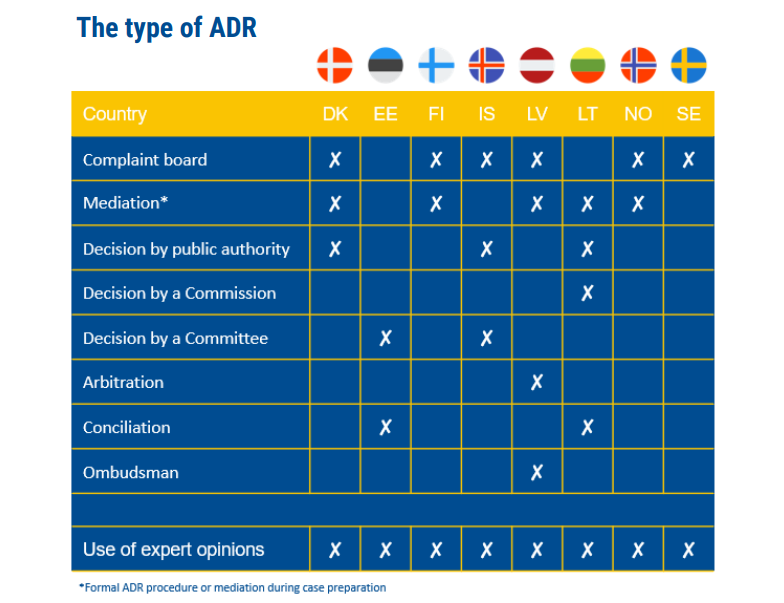
The Nordic and Baltic ADR schemes cover a wide range of different ADR models: Complaint Boards, Mediation, Conciliation, Commission, Decisions by public authorities, arbitration and Ombudsman. 

The average case handling time varies not only from country to country but also from one ADR entity to another. From 58 days as the shortest average case-handling time and 16 months as the highest. 

All countries have ADR entities that use expert opinions as part of the decision making.
Image
Image of different types of ADRs

Country-specific information on ADR schemes and procedures

  • Denmark

    • Mediation procedure
      The public residual ADR provides a mediation service. A legal case handler mediates via a conference call with the consumer and the trader. If the mediation is unsuccessful, the consumer can decide to escalate the complaint to a complaint board. 
    • Complaint board
      Most ADR entities make use of decisions issued by a complaint board. The complaint boards consist of one judge, two representatives appointed by consumer organisations and two representatives appointed by trader organisations. Decisions are based on a legal assessment of the case. Majority rulings. 
    • Decision by Public Authority
      Decisions issued by the Public Authority based on a legal assessment of the complaint. 

    Estonia

    • Consumer Disputes Committee
      Complaints assessed and decision made by the head of the committee together with one representative from business side (mostly trader organisations) and one representative from consumer side. The decision is not binding. 
    • Conciliation I
      Insurance ADR entities make use of concilitation. The conciliator tries to bring the parties to an agreement. If conciliation is unsuccessful, a decision is issued and, if relevant, the consumer can turn to court. 
    • Conciliation II
      At the Bar Association, the Court of Honor can make use of experts and witnesses when needed. The conciliator proposes a decision and the parties can agree or disagree. 

    Finland

    • Complaint board
      All three ADR entities make use of the complaint board model. For example, the Consumer Disputes Board comprises of various sections, each of which has four members plus an independent chairman who is typically a district court judge by profession. The members of the sections represent consumer interests as well as the business sector. Legal and other expertise is taken into account in selecting the members. 
    • Mediation procedure
      There may be an informal mediation phase before the case proceeds to the dispute process. The ADR entities use this option more or less. 

    Iceland

    • Most ADRs make use of decisions issued by a committee. The committees consist of a chairman appointed by the ministry and equal number of representatives appointed by consumer organisations and by trader organisations. Decisions are based on legal assessment of the case. Majority rulings. 

    Latvia

    • Complaint board
      The residual ADR acts as complaint board. It consists of a chairman (former judge) and representatives from consumer and trader organisations (one from each side). Decisions are based on a legal assessment of the case. Majority rulings. 
    • Ombudsman decision
      The ombudsman issues decisions based on a legal assessments of the cases. 
    • Mediation procedure - decisions
      The Latvian Motor Insurers Bureau ADR provides an opinion based on the outcome of a mediation procedure. 

    Lithuania

    • Combined procedures
      Most ADR entities have mixed procedures, eg.the main ADR has a mix of mediation and consilation. The ADR body starts the procedure with offering the dispute parties to make an amicable decision. If the agreement is not reached, the ADR body evaluates all the evidence, explanations of parties of the dispute and makes a decision based on legal acts and practice.
    • Authorised person
      The Communications Regulatory Authority has a decision of an authorized person. When a claim is received, a responsible investigating officer is appointed, the final decision is made by an authorized person (decision of a member of the Authority Council). 

    Norway

    • Mediation procedure
      The public residual ADR provides a mediation service. A legal case handler mediates via a conference call with the consumer and the trader. If the mediation is unsuccessful the consumer can decide to escalate the complaint to a complaint board. This complaint board is not at part of the Norwegian ADR system, but it is a public complaint board. 
    • Complaint board
      Most ADR entities make use of decisions issued by a complaint board. The complaint boards consist of one judge, one representative appointed by consumer organisations and one representative appointed by trader organisations. Decisions are based on a legal assessment of the case. Majority decision. 

    Sweden 

    • Complaint boards
      All ADR entities make use of decisions issued by a complaint board. Most complaint boards consist of one judge, two representatives appointed by consumer organizations and two representatives appointed by trader organizations. Decisions are based on an impartial legal assessment of the case. Majority decision.

    #types-of-adr-schemes

    Copied to clipboard!
  • Some national ADR entities have a shorter average case-handling time than others. The numbers presented here are the minimum and maximum averages, depending on the ADR entities.

    • Denmark: 67 - 220 days 
    • Estonia: 58 - 90 days 
    • Finland: 180 - 480 days 
    • Iceland: 30 - 210 days 
    • Latvia: 90 days 
    • Lithuania: 36 - 68 days 
    • Norway: 45 - 120 days 
    • Sweden: 90 - 360 days 

    Insights

    The main ADR in Lithuania (State Consumer Rights Protection Authority) is a good example of how a combination of mediation and consiliation procedure can be combined with binding decisions (if the dispute parties do not reach an amicable agreement in the beginning). If not disputed in court in 30 days the ADR decision becomes an enforceable document. Consumers can save time and money as they don’t have to go to court like in other cases where decisions are not binding and traders don’t follow them. 

    #average-case-handling-time

    Copied to clipboard!
  • Fees for consumers and costs for traders vary considerably from country to country as well as between national entities. In two countries, Finland and Lithuania, the ADR schemes are completely free of costs and fees for the consumers and traders.

    Image
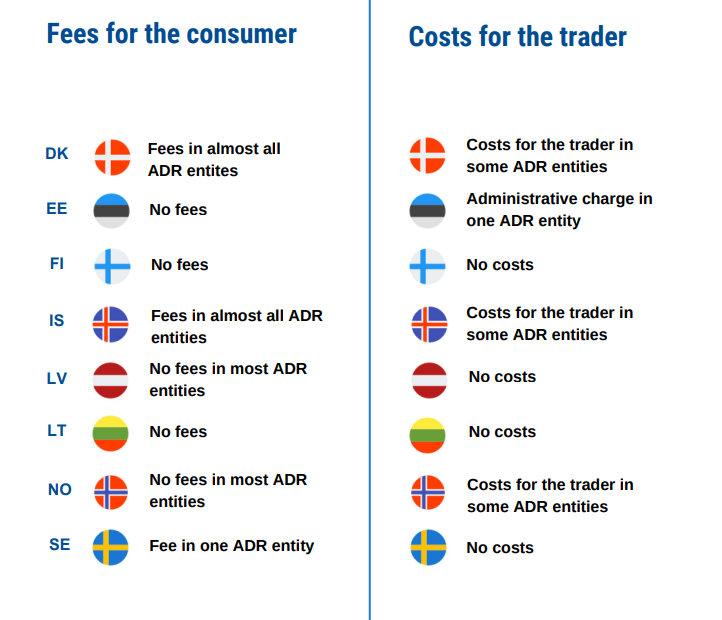
    Overview of ADR fees and costs

    Insights

    In Denmark an often used cost model differentiate the costs a trader has to pay to the ADR. The trader pays a reduced cost if the case is settled during the process at the ADR entity (sometimes depending on which phase the case has reached) and full cost if the decision is made in favor of the consumer. Usually, the trader pays no cost if the case is won. This way there is a build-in incitement for traders to avoid complaints to the ADR entity or to consider an early settlement of the case if the outcome is uncertain. 

    In Iceland consumer fees are kept as low as possible to ensure that access to ADR is not made difficult due to financial threshold. If the consumer wins a case (partially or in full) he or she generally gets the fee refunded. Usually, the trader pays no cost if the case is won. 

    In Estonia the draft law on amending the Consumer Protection Act is being reviewed. The main goal of the planned changes is to ensure simple, quick, cheap, impartial and fair resolution between traders and consumers. Among other planned amendments, changes in the cost model has been under discussion, but the process is still in its early stages. 

    In Norway the public residual ADR is financed by the government. Neither consumers nor traders have to pay a fee. In some other ADR entities the trader has to pay a small or bigger amount, sometimes depending on the outcome of the case. 

    In Lithuania, most ADR procedures are free of charge for consumers and traders. However, in cases where the main ADR body undertakes the inspection of a particular good or service, the costs for this inspection are covered by the trader if the consumer's request is satisfied

    #fees-and-costs

    Copied to clipboard!
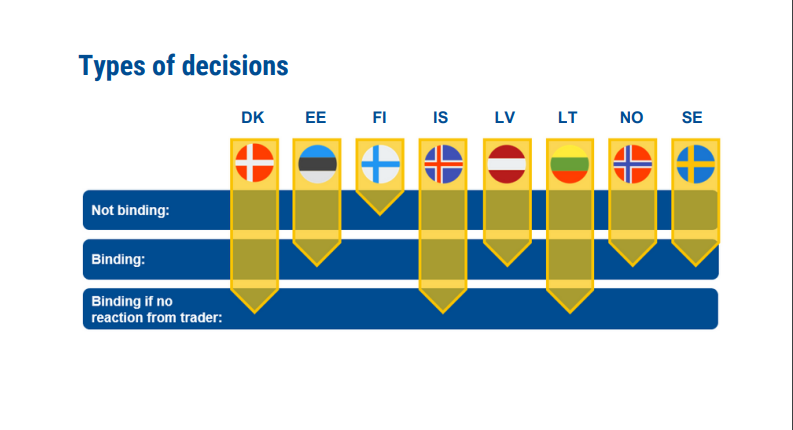
  • All countries have ADR entities that operate with non-binding decisions and all countries except Finland have ADR entities issuing binding decisions. 

    ADR entities in three countries – Denmark, Iceland and Lithuania – issue decisions that become binding if the traders do not challenge the decisions. 

    With a few excemptions, the compliance rates are very high in the Baltic and Nordic countries – between 70 to 100 %.

    ADR decisions compliance rates 

    • Denmark: 84-100%
    • Estonia: 64-100% 
    • Finland: 70-100% 
    • Iceland: 83-100% 
    • Latvia: 40-71% 
    • Lithuania: 33-100% 
    • Norway: Not available 
    • Sweden: 78%
    Image
    Image with the different type of descisions per country


    What is a binding decision in cases where the trader does not react? 

    If the trader does not react, the decision becomes automatically enforceable upon the expiry of the deadline. Denmark, Iceland and Lithuania make use of this type of decisions. 

    This means that consumers get enforceable ADR decisions in the cases where the trader does not participate in the ADR procedure or ignore a decision. 

    In Denmark and Iceland, a trader that wants to avoid being bound by an ADR decision has to notify the ADR within 30 days after receipt of the decision that the decision will not be honored. In Lithuania, a trader that wants to avoid being bound by an ADR decision has to turn to court within 30 days after the adaption of the decision. 

    These types of decisions put pressure on the trader to react to an ADR decision in favor of the consumer and it strengthens the validity of the ADR entities. At the same time these types of decisions do not prevent the traders from going to court in a situation where the trader find it reasonable to challenge the ADR decision. 

    High compliance rate with non-binding decisions in Finland

    The Finnish ADR scheme has a long tradition helping consumers – the ADR entities (or their predecessors) were established decades ago. Transparent decision-making practices, strong expertise and the trust built over the years may explain why the majority of traders are willing to comply with non-binding ADR decisions. 

    Secondly, publicity matters. Traders that do not comply with ADR decisions are usually named. The Finnish media is usually interested in publishing articles about well-known traders that refuse to act according to the decision. This may have a deterrent effect.

    #decisions
    Copied to clipboard!
  • Norway is the only country without any publicly available information about traders that do not comply with ADR decisions. 

    In all other countries there are different types of "naming and shaming" publications. No country has a complete list of traders that do not comply with decisions from all ADR entities.

    Public information about traders that do not comply with ADR decisions (“naming and shaming”)

    • Denmark
      Yes - some ADR entities publish names of traders not complying with decisions if they do not go to court to challenge the decision. 
    • Estonia
      Yes - Consumer Protection and Technical Regulatory Authority holds a "black list" of traders who do not comply with the Consumer Disputes Committee's decision. Unfortunately, even having only four notified ADR bodies, they do not cooperate regarding a mutual black list in Estonia. Therefore, we do not have a comprehensive black list of traders that would cover all ADR bodies. 
    • Finland
      The Consumer Disputes Board does not have a separate list of traders that do not comply with decisions given by the Board. However, all documents related to a complaint, including information on whether a given decision was complied with, are archived and available to the general public upon request. In addition, there is a black list that is maintained by the Kuluttaja (Consumer) magazine. If a trader does not follow the decision of the Consumer Disputes Board, it will end up on that list. The magazine is published by an association founded by the Consumers’ Union of Finland (nongovernmental consumer organisation). 

      The Traffic Accident and Patient Injury Board (Traffic Accident Department) does not name the parties that do not comply with its decisions. However, the number of cases where the decision was not followed is published every year. 

      The Finnish Financial Ombudsman Bureau publishes information on the compliance rate on their website: the Bureau lists all traders, how many complaints there have been per each trader, and whether traders have complied with decisions. 
    • Iceland
      Yes – for The Complaint board for goods and services, and for our NEB the names of traders is mentioned and published. 
    • Latvia
      Yes - Latvian Consumer Rights Protection Centre in it's web-page maintains a black list of traders that do not fulfill decisions of Consumer Disputes Resolution Commission. 
    • Lithuania
      Yes - State Consumer Rights Protection Authority publishes all decisions on their website with traders names, and when sanctions are imposed, the State Consumer Rights Protection Authority publishes press releases where the trader are named. National Energy Regulatory Council publishes decisions with trader names on their website. When a trader does not comply with decision, the Bank of Lithuania announces it publicly on their website in 7 days after non-implementation. 
    • Norway
      No public information about traders who do not comply with ADR decisions. No black list in Norway. 
    • Sweden
      Yes - As the boards are public, there is usually access to the decisions if requested. An impartial magazine usually publishes annually a list of traders who do not follow ARN's decisions, called the "black list".

    #public-information

    Copied to clipboard!