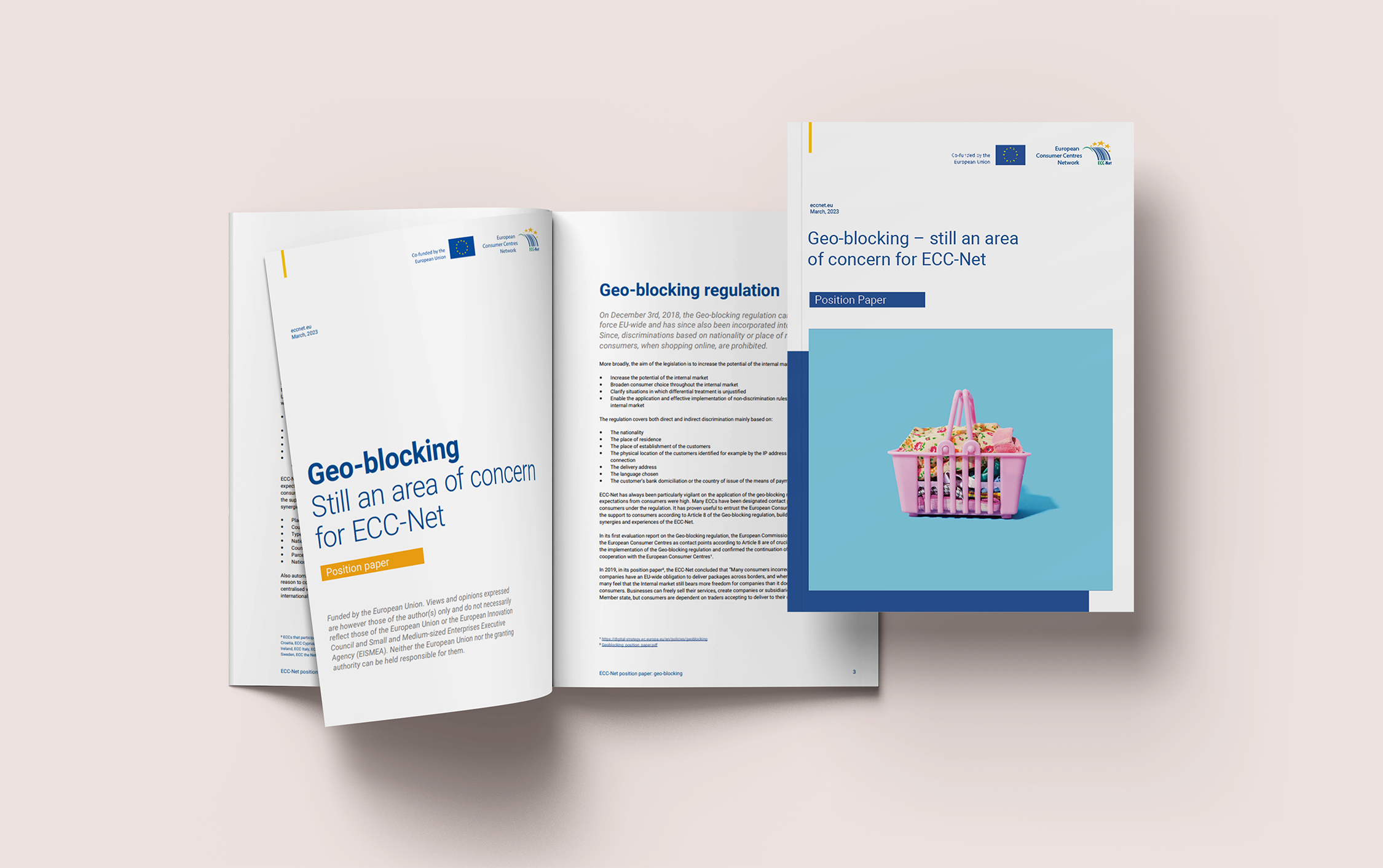
Geo-blocking – still an area of concern for ECC-Net
EU Geo-blocking Regulation raised many expectations among consumers who hoped they would finally abe able to access goods and services at better prices throughout the EU. To what extent have consumers’ expectations been met? Read ECC-Net's view on this matter.
Geo-blocking: still an area of concern for ECC-Net
Funded by the European Union. Views and opinions expressed are however those of the author(s) only and do not necessarily reflect those of the European Union or the European Innovation Council and Small and Medium-sized Enterprises Executive Agency (EISMEA). Neither the European Union nor the granting authority can be held responsible for them.
Geo-blocking regulation
On December 3rd, 2018, the Geo-blocking regulation came into force EU-wide and has since also been incorporated into EEA law. Since, discriminations based on nationality or place of residence of consumers, when shopping online, are prohibited.
More broadly, the aim of the legislation is to increase the potential of the internal market:
- Increase the potential of the internal market
- Broaden consumer choice throughout the internal market
- Clarify situations in which differential treatment is unjustified
- Enable the application and effective implementation of non-discrimination rules throughout the internal market
The regulation covers both direct and indirect discrimination mainly based on:
- The nationality
- The place of residence
- The place of establishment of the customers
- The physical location of the customers identified for example by the IP address of their connection
- The delivery address
- The language chosen
- The customer‘s bank domiciliation or the country of issue of the means of payment
ECC-Net has always been particularly vigilant on the application of the geo-blocking regulation as expectations from consumers were high. Many ECCs have been designated contact points for consumers under the regulation. It has proven useful to entrust the European Consumer Centres with the support to consumers according to Article 8 of the Geo-blocking regulation, building on existing synergies and experiences of the ECC-Net.
In its first evaluation report on the Geo-blocking regulation, the European Commission stated that the European Consumer Centres as contact points according to Article 8 are of crucial importance for the implementation of the Geo-blocking regulation and confirmed the continuation of the cooperation with the European Consumer Centres.
Main findings of ECC-Net's position paper (2019)
In 2019, in its position paper, the ECC-Net concluded that “Many consumers incorrectly assume that companies have an EU-wide obligation to deliver packages across borders, and when this is refused many feel that the Internal market still bears more freedom for companies than it does for consumers. Businesses can freely sell their services, create companies or subsidiaries in another Member state, but consumers are dependent on traders accepting to deliver to their country.”
- The exact scope of application of the geoblocking regulation is unclear to consumers.
- The absence of obligation to deliver to the consumer’s country of residence makes it, in practice, difficult or impossible to have access to all offers.
- The possibility of redirection to national websites and price differences still exist and y frustrate consumers.
- The idea of “shopping like a local” is only interesting in border regions where distances are short.
- The problem of geo-blocking also seems, in certain countries, to be linked to the “SEPA issues” as consumers are refused to sign contracts based on the domiciliation of their bank account.
- Also credit cards may be refused, despite Article 5 of the regulation, either directly by the merchant or by the service provider the merchant uses and which allows the blocking of credit cards from specific countries, often advertised as a fraud prevention mechanism.
Barriers for EU consumers in 2023
In 2023 it was time to have a look if these main conclusions have changed. 25 ECCs* have agreed to look into the queries they receive to extract the most common consumer reasons to complain. Unfortunately, no evolution can be seen since 2019. The most important barriers for consumers when wanting to shop from another country still are:
- Higher purchase prices due to the place of residence/nationality of the consumer not justified by different VAT rates,
- Sales and promotional offers accessible only in specific countries,
- Selective distribution, and purchases refused even in cases of passive sales,
- The impossibility to obtain delivery to the consumer’s country
- When delivery is possible, high delivery costs, expensive return costs,
- The (non)acceptance of (pre)payment methods, when using a payment means issued in another country.
ECC-Net has always been particularly vigilant on the application of the geo-blocking regulation as expectations from consumers were high. Many ECCs have been designated contact points for consumers under the regulation. It has proven useful to entrust the European Consumer Centres with the support to consumers according to Article 8 of the Geo-blocking regulation, building on existing synergies and experiences of the ECC-Net.
- Place of residence
- Country of origin of the bank account or credit card
- Type of means of payment
- Nationality
- Country of origin of the telephone number,
- Parcel forwarding services as delivery address,
- National social security numbers or tax identification numbers
Also automatic redirection to country specific websites still exist, even if they have become less reason to complain. It should also be highlighted that country-specific websites redirecting from a centralised web portal (like an .eu and .com). This business model has become the norm for international online traders
Scope of the Geo-blocking Regulation
ECCs also noted that even though awareness has increased, the exact coverage and scope of the geo-blocking regulation is still not known to consumers. Also confusion exists with regard to other legal instruments such as portability of content, access to digital services such as Apps, exclusive/selective distribution rules, author or intellectual property rights protection or even TV and radio broadcast across borders.
Distribution of physical goods
In terms of selective distribution of physical goods, some online traders, especially small traders, find it impossible to offer delivery of goods to certain locations because they are unable to find a shipping partner or service (in-country and last-mile delivery) at that location, and this despite the European Commission’s efforts to ensure that citizens and small businesses have access to reasonably priced cross-border parcel delivery services, such as Regulation (EU) 2018/644 on cross-border parcel delivery services.
No obligation to deliver cross-border
Those consumers who know about the geo-blocking regulation mistakenly think that traders have to deliver cross-border. When they learn that this isn’t the case, they are very disappointed. The geo-blocking regulation does not require merchants to deliver the goods or services to customers all over the EU; they can choose the geographical area in which they will physically deliver the goods or services but this essentially prevents the completion of the sale, whose result is the delivery. The obligation set on traders is to make the content accessible in all EU locations but there is no obligation for the trader to authorise the sale based on delivery location (which, again, negates the sale).
Difficulties with 'Shopping like a local'
Putting in place “shopping like a local” is difficult in e-commerce as not many consumers have a delivery address in another country, know how to set them up or find traders accepting them. They also generate additional costs, which often make the price advantage when shopping in another country void, or create an additional risk for consumers when the parcel goes missing or is damaged after delivery to these facilities.
Self collection possibilities such as “click and collect” do not always hold their promises either as even traders who offer self collection to their national residents are refusing the same option to consumers from other countries.
Banking practices are not aligned
The cross-border banking practices are also an impediment to distribution, so another factor for tackling geo-blocking is ensuring full application of the SEPA regulation as well as improving SEPA processes for banks and traders but also regulating payment processors (authorised but functioning outside of the national and European banking systems), some of which only have a limited geographical business coverage.
ECCs also call out for:
- Full enforcement of the SEPA regulation and Article 5 of the Geo-blocking regulation
- Sweeps, joint actions and enforcement of the Geo-blocking regulation, including on discrimination in passive sales constellations.
* ECCs that participated and agree with the information mentioned in the response: ECC Austria, ECC Belgium, ECC Bulgaria, ECC Croatia, ECC Cyprus, ECC Czechia,ECC Denmark, ECC Estonia, ECC Finland, ECC France, ECC Germany, ECC Hungary, ECC Iceland, ECC Ireland, ECC Italy, ECC Latvia, ECC Lithuania, ECC Luxemburg, ECC Malta, ECC Norway, ECC Poland, ECC Portugal, ECC Slovakia, ECC Sweden, ECC the Netherlands.